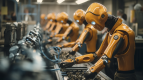
Smart Robotics in Manufacturing: AI for Perception, Planning, and Control Training Course
Intelligent robotics involves embedding artificial intelligence into robotic systems to enhance perception, decision-making capabilities, and autonomous control.
This instructor-led training (available online or on-site) is designed for advanced robotics engineers, systems integrators, and automation leads who want to implement AI-driven perception, planning, and control within smart manufacturing environments.
Upon completing this training, participants will be able to:
- Comprehend and apply AI techniques for robotic perception and sensor fusion.
- Create motion planning algorithms for both collaborative and industrial robots.
- Implement learning-based control strategies to enable real-time decision-making.
- Integrate intelligent robotic systems into smart factory workflows.
Course Format
- Interactive lectures and discussions.
- Extensive exercises and practice sessions.
- Hands-on implementation within a live-lab environment.
Customization Options
- For a customized training session, please contact us to make arrangements.
Course Outline
Introduction to Intelligent Robotics and AI Integration
- Overview of robotics in Industry 4.0
- The role of AI in perception, planning, and control
- Software and simulation environments
Perception Systems and Sensor Fusion
- Computer vision for robotics (2D/3D cameras, LiDAR)
- Sensor calibration and fusion techniques
- Object detection and environment mapping
Deep Learning for Perception
- Neural networks for visual recognition
- Using TensorFlow or PyTorch with robotic data
- Training perception models for object tracking
Motion Planning and Path Optimization
- Sampling-based and optimization-based planning
- Working with MoveIt for motion planning
- Collision avoidance and dynamic re-planning
Learning-Based Control Strategies
- Reinforcement learning for robotic control
- Integrating AI into low-level control loops
- Simulation with OpenAI Gym and Gazebo
Collaborative Robots (Cobots) in Smart Manufacturing
- Safety standards and human-robot collaboration
- Programming and integrating cobots with AI
- Adaptive behaviors and real-time responsiveness
System Integration and Deployment
- Interfacing with industrial controllers (PLC, SCADA)
- Edge AI deployment for real-time robotics
- Data logging, monitoring, and troubleshooting
Summary and Next Steps
Requirements
- Understanding of robotic systems and kinematics
- Experience with Python programming
- Familiarity with AI or machine learning concepts
Audience
- Robotics engineers
- Systems integrators
- Automation leads
Open Training Courses require 5+ participants.
Smart Robotics in Manufacturing: AI for Perception, Planning, and Control Training Course - Booking
Smart Robotics in Manufacturing: AI for Perception, Planning, and Control Training Course - Enquiry
Smart Robotics in Manufacturing: AI for Perception, Planning, and Control - Consultancy Enquiry
Upcoming Courses
Related Courses
AI-Powered Predictive Maintenance for Industrial Systems
14 HoursPredictive maintenance for industrial systems, powered by artificial intelligence, utilizes machine learning and data analytics to anticipate equipment failures and refine maintenance schedules. This approach shifts organizations from reactive maintenance models to proactive strategies, resulting in improved operational uptime, reduced costs, and extended asset lifespan.
This instructor-led live training, available either online or on-site, is designed for intermediate-level professionals seeking to deploy AI-driven predictive maintenance solutions within industrial settings.
Upon completing this training, participants will be capable of:
- Distinguishing predictive maintenance from reactive and preventive maintenance strategies.
- Collecting and organizing machine data for artificial intelligence analysis.
- Applying machine learning models to identify anomalies and forecast failures.
- Implementing comprehensive workflows that transform sensor data into actionable insights.
Course Format
- Interactive lectures and discussions.
- Practical exercises and case studies.
- Live demonstrations and hands-on data workflows.
Options for Customizing the Course
AI for Process Optimization in Manufacturing Operations
21 HoursAI for Process Optimization involves utilizing machine learning and data analytics to boost efficiency, quality, and throughput within manufacturing operations.
This instructor-led training (available online or onsite) is designed for intermediate-level manufacturing professionals looking to leverage AI techniques to streamline operations, minimize downtime, and drive continuous improvement.
By the conclusion of this training, participants will be capable of:
- Grasping AI concepts pertinent to manufacturing optimization.
- Collecting and preparing production data for analysis.
- Implementing machine learning models to identify bottlenecks and forecast failures.
- Visualizing and interpreting results to facilitate data-driven decision-making.
Format of the Course
- Interactive lecture and discussion.
- Numerous exercises and practice sessions.
- Hands-on implementation in a live-lab environment.
Course Customization Options
- To request customized training for this course, please contact us to arrange.
AI for Quality Control and Assurance in Production Lines
21 HoursAI for Quality Control involves utilizing computer vision and machine learning methods to identify defects, anomalies, and deviations within production processes.
This instructor-led, live training (available online or onsite) targets beginner to intermediate quality professionals who want to apply AI tools to automate inspections and enhance product quality in manufacturing settings.
Upon completing this training, participants will be capable of:
- Understanding the application of AI in industrial quality control.
- Collecting and labeling image or sensor data from production lines.
- Leveraging machine learning and computer vision to detect defects.
- Developing basic AI models for anomaly detection and yield forecasting.
Course Format
- Interactive lectures and discussions.
- Numerous exercises and practical practice.
- Hands-on implementation in a live-lab environment.
Course Customization Options
- To request customized training for this course, please contact us to arrange.
AI for Supply Chain and Manufacturing Logistics
21 HoursLeveraging AI in Supply Chain and Manufacturing Logistics involves applying predictive analytics, machine learning, and automation to streamline inventory management, optimize routing, and improve demand forecasting.
This instructor-led training, available online or on-site, is designed for intermediate-level supply chain professionals looking to utilize AI-driven tools to boost logistics performance, achieve accurate demand forecasts, and automate warehouse and transportation operations.
Upon completing this course, participants will be equipped to:
- Grasp how AI is integrated into logistics and supply chain workflows.
- Implement machine learning models for demand forecasting and inventory management.
- Analyze and optimize transport routes using AI techniques.
- Automate decision-making processes within warehouses and fulfillment centers.
Course Format
- Interactive lectures and group discussions.
- Extensive exercises and practical practice.
- Hands-on implementation within a live laboratory environment.
Customization Options
- For customized training options, please reach out to us to make arrangements.
Introduction to AI in Smart Factories and Industrial Automation
14 HoursArtificial Intelligence in Smart Factories involves applying AI technologies to automate, monitor, and optimize industrial operations in real time.
This instructor-led live training, available online or onsite, is designed for beginner-level decision-makers and technical leads who want a strategic and practical introduction to leveraging AI within smart factory environments.
Upon completing this training, participants will be able to:
- Grasp the fundamental principles of AI and machine learning.
- Recognize key AI use cases in manufacturing and automation.
- Explore how AI facilitates predictive maintenance, quality control, and process optimization.
- Assess the steps required to launch AI-driven initiatives.
Course Format
- Interactive lectures and discussions.
- Real-world case studies and group exercises.
- Strategic frameworks and implementation guidance.
Course Customization Options
- To arrange customized training for this course, please contact us.
Hands-on Workshop: Implementing AI Use Cases with Industrial Data
21 HoursImplementing AI Use Cases employs a practical, project-focused methodology to apply machine learning, computer vision, and data analytics to address real-world industrial challenges, utilizing real or simulated datasets.
This guided, live training session (available online or in-person) targets intermediate-level cross-functional teams looking to collaboratively deploy AI solutions that align with their operational objectives, gaining valuable experience with industrial data pipelines.
Upon completion, participants will be equipped to:
- Identify and define practical AI use cases within operations, quality assurance, or maintenance.
- Collaborate across different roles to build machine learning solutions.
- Manage, clean, and analyze a variety of industrial datasets.
- Develop and present a functional prototype of an AI-driven solution based on a chosen use case.
Course Format
- Interactive lectures and discussions.
- Collaborative group exercises and project work.
- Practical implementation within a live laboratory environment.
Customization Options
- To request a tailored training version of this course, please get in touch with us to arrange it.
Developing Intelligent Bots with Azure
14 HoursAzure Bot Service integrates the capabilities of the Microsoft Bot Framework and Azure Functions to offer a robust platform for rapidly constructing intelligent bots.
During this instructor-led live training, attendees will discover how to effectively develop intelligent bots using Microsoft Azure.
Upon completing the training, participants will be able to:
Comprehend the fundamental concepts underlying intelligent bots.
Construct intelligent bots leveraging cloud-based applications.
Acquire practical expertise in the Microsoft Bot Framework, the Bot Builder SDK, and Azure Bot Service.
Implement established bot design patterns within real-world scenarios.
Develop and deploy their initial intelligent bot utilizing Microsoft Azure.
Audience
This course is tailored for developers, hobbyists, engineers, and IT professionals with an interest in bot development.
Course Format
The training blends lectures and discussions with exercises, placing a strong emphasis on hands-on practice.
Developing a Bot
14 HoursA bot or chatbot functions as a digital assistant designed to automate user interactions across various messaging platforms, enabling faster task completion without requiring direct contact with a human agent.
In this instructor-led live training, participants will learn how to begin developing bots by creating sample chatbots using established bot development tools and frameworks.
By the conclusion of this training, participants will be able to:
- Identify the various uses and applications of bots
- Grasp the complete process involved in bot development
- Explore the diverse tools and platforms utilized for building bots
- Construct a sample chatbot for Facebook Messenger
- Build a sample chatbot using the Microsoft Bot Framework
Audience
- Developers interested in creating their own bots
Format of the course
- Part lecture, part discussion, exercises, and extensive hands-on practice
Building Digital Twins with AI and Real-Time Data
21 HoursDigital Twins are virtual representations of physical systems, augmented by real-time data and AI-powered analytics.
This instructor-led live training (available online or onsite) is designed for intermediate-level professionals looking to create, deploy, and optimize digital twin models leveraging real-time data and AI-driven insights.
Upon completion of this training, participants will be capable of:
- Comprehending the architecture and core components of digital twins.
- Utilizing simulation tools to model complex systems and environments.
- Integrating real-time data streams into virtual models.
- Applying AI techniques for predictive behavior analysis and anomaly detection.
Course Format
- Interactive lectures and discussions.
- Ample exercises and practice sessions.
- Hands-on implementation within a live-lab environment.
Customization Options
- For a customized training experience, please contact us to arrange.
Edge AI for Manufacturing: Real-Time Intelligence at the Device Level
21 HoursEdge AI involves deploying artificial intelligence models directly onto devices and machinery at the network's edge, enabling real-time decision-making with minimal latency.
This instructor-led, live training (available online or onsite) is designed for advanced-level embedded and IoT professionals who want to deploy AI-driven logic and control systems in manufacturing environments where speed, reliability, and offline operation are critical.
Upon completing this training, participants will be able to:
- Understand the architecture and advantages of edge AI systems.
- Build and optimize AI models for deployment on embedded devices.
- Utilize tools such as TensorFlow Lite and OpenVINO for low-latency inference.
- Integrate edge intelligence with sensors, actuators, and industrial protocols.
Format of the Course
- Interactive lecture and discussion.
- Numerous exercises and practice sessions.
- Hands-on implementation in a live-lab environment.
Course Customization Options
- To request a customized training for this course, please contact us to arrange.
Industrial Computer Vision with AI: Defect Detection and Visual Inspection
14 HoursIndustrial computer vision combined with AI is reshaping the way manufacturers and quality assurance teams identify surface flaws, verify part compliance, and automate visual inspection workflows.
This instructor-led, live training (available online or onsite) targets intermediate to advanced-level QA teams, automation engineers, and developers looking to design and implement computer vision systems for defect detection and inspection using AI methodologies.
Upon completion of this training, participants will be equipped to:
- Grasp the architecture and key components of industrial vision systems.
- Develop AI models for visual defect detection utilizing deep learning.
- Integrate real-time inspection pipelines with industrial cameras and hardware.
- Deploy and optimize AI-driven inspection systems within production environments.
Course Format
- Interactive lectures and discussions.
- Extensive exercises and practice sessions.
- Hands-on implementation in a live laboratory environment.
Course Customization Options
- To request customized training for this course, please contact us to make arrangements.
Smart Robots for Developers
84 HoursAn Intelligent Robot is an Artificial Intelligence (AI) system capable of learning from its environment and past experiences to enhance its capabilities based on that knowledge. These robots can collaborate with humans, working alongside them and observing their behavior. Beyond performing manual labor, they are also equipped for cognitive tasks. Intelligent Robots can be purely software-based, residing on a computer as an application without moving parts or physical interaction, in addition to being physical robots.
In this instructor-led live training, participants will explore the various technologies, frameworks, and techniques used to program different types of mechanical Intelligent Robots, applying this knowledge to complete their own robot projects.
The course is structured into 4 sections, each covering three days of lectures, discussions, and hands-on robot development in a live lab environment. Each section concludes with a practical project, allowing participants to practice and demonstrate their acquired skills.
The hardware for this course is simulated in 3D using simulation software. Programming is conducted using the open-source ROS (Robot Operating System) framework, along with C++ and Python.
Upon completion of this training, participants will be able to:
- Grasp the core concepts underlying robotic technologies.
- Understand and manage the interaction between software and hardware in a robotic system.
- Understand and implement the software components that form the foundation of Intelligent Robots.
- Build and operate a simulated mechanical Intelligent Robot capable of seeing, sensing, processing, grasping, navigating, and interacting with humans via voice.
- Enhance an Intelligent Robot's ability to perform complex tasks through Deep Learning.
- Test and troubleshoot an Intelligent Robot in realistic scenarios.
Target Audience
- Developers
- Engineers
Course Format
- A mix of lectures, discussions, exercises, and extensive hands-on practice.
Note
- To customize any aspect of this course (e.g., programming language, robot model), please contact us to arrange.